
Two possibilities exist: Either we are alone in the Universe or we are not. Both are equally terrifying.
ARTHUR C. CLARKE
For all the
teeming diversity of the gods that someone, somewhen, has decided just might be
worth worshiping – and we could be
talking about Yahweh or Allah, Ishtar
or Thor – they all have something in
common. Despite running the gamut from the chthonic to sublime, and
apart from superficialities like Thoth’s
ibis-like head or the Buddha’s retractable penis, the
fact is that they are all decidedly human.
They hardly represent a random sampling of all
possible gods. Rather they’re a conspicuous
subset that are more or less like humanity and, crucially, they all speak to decidedly
human concerns. While I lean towards the idea that we have a need to populate
the heavens with forces that reflect our needs , note that this isn’t an
argument against their existence per se.
It’s entirely possible that the proliferation of deities that care about
humanity’s concerns might arise out of the actual existence of powers concerned
with the cares of humans. That said, this is as good an argument for Tiamat or Baal as it is for Vishnu or Ahura Mazda. If you
challenge an unbeliever on account of Christ they could point out the godly
horde you’ve ignored, and say , “I’ve just gone one better”.
So the
properly agnostic and newly minted proto-believer in the market for a god can’t
help notice that there are gaps between the usual suspects. In between the
franchise operations of the big boys – Christianity, Islam, Judaisim, Hinduism
etc – and aside from the Ma & Pa
operations of smaller religions there are odd gaps where gods should be. We’re
all familiar with the idea of a god with the Big Three: omnipotence,
omniscience and benevolence. But where are all the gods that are omniscient but
powerless, or omnipotent but blind? What about a god that’s omnipotent only on
Tuesdays (Thank you, Pascal
Boyer)? Or, to give an example from David
Eagleman’s Sum: Forty Tales from the Afterlives
what if god does in fact exist and is intimately concerned with the lives of
the special creations for whom he made the universe: single cells. What if
these constructs we call humans are just not on the scale god cares about?

The itch
that drove me to write this post was a discussion about evolution and
intelligent design. Intelligent design looks for instances of irreducible
complexity in the natural world, on the theory that a phenomenon – usually a
feature of a biological organism – that can’t be explained by the incremental accretion of
adaptations is prima facie evidence
of the existence of an intelligent designer, a god. A well-worn trope of this
kind is the eye: what use, they say, is half an eye? More contemporary examples
might include the motive
equipment of certain viruses or the explosive back-end
of the bombardier beetle. Without getting into an argument about the merit
of these examples, I want to draw out the thinking that’s implicit in this
approach: It only allows for two alternatives: either evolution by natural
selection is responsible, or else an ‘intelligent designer’ – read as ‘My God’
– did it. This ignores other possible explanations and sets up a false
dichotomy: an artificial division of a range of possibilities into a rigid
binary opposition. In the spirit of exploring all possibilities: if in fact an
instance of ‘irreducible complexity’ was found that couldn’t be explained by evolution
by natural selection, is the only other choice intelligent design? I can think
of at least one alternative: a so-called ‘thermodynamic miracle’. This would be
an event – such as oxygen spontaneously becoming gold – that makes use of
natural processes and has a finite probability, albeit one whose odds are so
long they are unlikely to occur in the lifetime of the universe. My point isn’t
to advocate for one of these ideas over the others, rather it’s to illustrate
how the standard approach is restricted, and in fact relies on this restriction
for its persuasiveness. To take another example, the argument from a First
Cause sets up a dichotomy where either the universe was created at some point
by a cause that caused itself- a self-causing cause - or otherwise we have an porportedly
‘impossible’ infinite regression. By what evidence is infinite regression
deemed impossible? And if ‘intelligent designer’ usually implies ‘my god’ so
does ‘first cause’: the argument usually comes with extra associations attached
to the first cause that aren’t merited by the argument itself. As
we’ve discussed before – nothing in the argument says anything about
omnipotence or unity of being let alone tridents or lightning bolts.
Of course,
logic is a fickle blade, and it can cut the other way too. Last time I touched
on the Anthropic Principle,
the idea that any explanation of us and our universe has to be consonant with
our existence in it. It has to account for – allow for – the existence of us. Life
seems to be such an odd thing and the prerequisites for its generation so
chancy that any explanation needs to account for the long odds that must have
been played the one time that we know for sure it happened. Maybe given
universe enough and time life is just something that can happen in the role of
the cosmic dice. But it’s hard
to even know if we have something to explain if we don’t know exactly how
long the odds are. For all the amazing
development of molecular biology and associated fields in the past century we
are far from knowing all the antecedents for life, let alone thinking,
reasoning human life. Attempts to attach estimates to the variables that might
count – such as the Drake
equation – are pretty hairy: they’re necessarily parochial and can only
include those things we know are required for our kind of life and obviously
don’t (can’t) take account of the unknown unknowns. What are all the factors
that lead to a) a sun which can b) support planets which can c) support a kind of life that can d) include the kind of intelligence which
might do things like e) building space
ships?
Interestingly
enough, even if you put relatively conservative numbers into the Drake
equation, you get a picture of a universe that’s positively teeming with life.
Hell, the fact that this is so, despite our never having met any of this life
even has a name: the Fermi
Paradox. The Fermi paradox is a mainstay of science fictional exploration precisely
because it’s such an ill-posed problem: we have no idea what the contributing
factors might be. Maybe there is intelligent life out there, but it’s so
different that we would never notice one another. Maybe there’s some kind of bottleneck
that all civilizations have to go through and few manage it: cf. the
development of nuclear weapons or fossil fuel-based economies. A particular favourite
of mine is the playful idea that apocalypse by zombie – or mass Spontaneous
Necro-Animation Psychosis – is relatively common in the universe, and that
each time a hopeful new space-faring society starts out to conquer the galaxy
it meets a infected planet and the inevitable epidemic of zombie-ism nips that galactic
empire in the bud. I’m not just conducting a whiplash tour of wacky out-there ideas;
I have a point, though possibly just barely. It seems to me while zombies might
be on a list of solutions to the Fermi paradox, I don’t remember seeing the
possibility of special creation by a concerned deity being seriously discussed
as a possibility. Imagine the implications of that: we, alone in the universe,
are the only kind of creatures like us. Then imagine this is precisely how our creator wanted it...
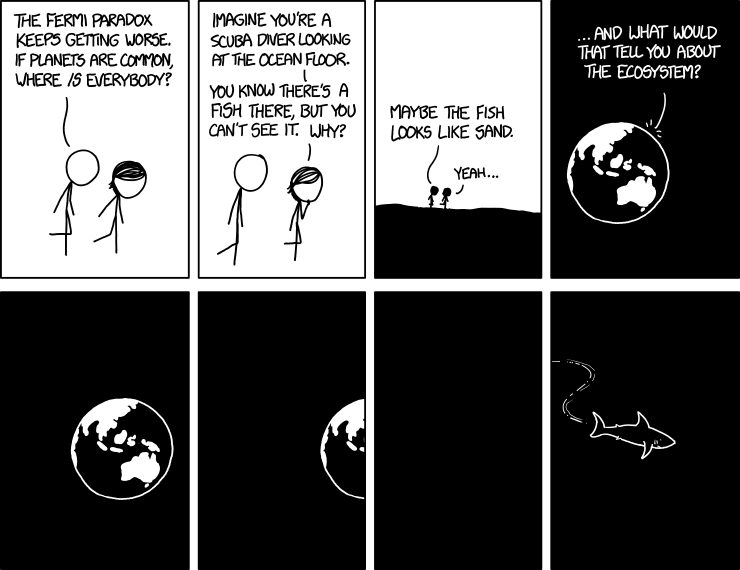 |
| XKCD: Fish |
 This work is licensed under a Creative Commons Attribution-NonCommercial-ShareAlike 3.0 Unported License.