Showing posts with label Darwinism. Show all posts

Saturday, 19 October 2013

Holy bookclub, Batman: The Gods of Fish and Men


Some recommended reading this time. Are you sitting comfortably? Then I'll begin...

Immense, of fishy form and mind,
Squamous, omnipotent, and kind;
And under that Almighty Fin,
The littlest fish may enter in.
Excerpt from Heaven, by Rupert Brooke.

 
I came across the poem ‘Heaven’, from which the above is an excerpt, in a book I’m reading at the moment, The Varieties of Scientific Experience by Carl Sagan. The title alludes to another book I’ve mentioned before: The Varieties of Religious Experience, by William James. Both are collections of the respective authors’ contributions to the Gifford Lectures on Natural Theology – the knowledge of god accessible not by revelation but by experience and reason. In 1901 James used his lectures to argue for the role of science in the study of religion, and set out his vision of what that might mean. Sagan - an astrophysicist and science communicator par excellence – used his lectures in 1985 to set out why he felt the proper exercise of scepticism does not preclude a sense of the sacred in our approach to the universe, but why human religions, such as they are, fail to capture it. Awe and wonder - says Sagan - are the only proper reactions to the majesty of creation, all the more so if we take modern ideas about its scale and complexity seriously. Indeed, it’s precisely the appreciation of this scale that makes earthly religions seem so parochial – for all the swarming diversity of human religious forms, they do not represent the full set of logically possible types of gods, beings and forces. Rather, they seem to speak to a much smaller set of conspicuously human concerns. Hence the poem: from a neutral perspective, would the anthropocentrism of our revealed religions appear all that different from the poem's fishy theology?

Sceptical scrutiny is the means, in both science and religion, by which deep thoughts can be winnowed from deep nonsense. - Carl Sagan

Another book I’ve read recently – Religion Explained , by anthropologist Pascal Boyer – also draws lessons from the ways in which human religion varies and the ways in which it seems to embody common concerns. He starts by outlining why religion unto itself is a phenomenon demanding an explanation, as a peculiar form of human behaviour and not just a specific manifestation of general cultural activity. He also set out why he thinks the common garden explanations typically proposed – religion as Existential Consolation, as Primitive Science, as Failure of Proper Thinking and so on – fail to do the job: no one of them accounts for the all the actual ways and manners in which religion is practiced. His proposal is that religious ideas and ritual activate a specific set of evolved psychological tendencies – that facilitates their general plausibility to mankind – in combination with specific violations of the expectations of those systems, explaining the endless interest such ideas engender. That’s a little lacking in detail I know, but I don’t want to get drawn into the detail here and the argument is set out in entertaining psychological and anthropological detail well worth the read even if you don’t buy his perspective. I’m not personally sure he succeeds in providing an explanation of religion in isolation. What I want to draw out here is the sense in which its easy to point to religious or spiritual feeling when you see it, but much harder to separate it off as a proper category all unto itself.

 “For small creatures such as we the vastness is bearable only through love.” - Carl Sagan

One domain in which people sometimes seek to maintain a thick and fast division between science and religion is ethics – insomuch as the latter is meant to be a proper source while he former is not. I’m all for appropriate wariness as regards the naturalistic fallacy (https://en.wikipedia.org/wiki/Naturalistic_fallacy) – deriving an ought from an is – but another of my recent reads has got me thinking about the ethics embedded in the practice of and motivation to do science. Its fiction this time, Antarctica by Kim Stanley Robinson. Among other things, it’s an exploration of the ideals embedded in science – the perfectibility or at least improvability of knowledge, the attempt to view things from outside of a human-centric perspective – and the treaty-model of Antartica as a ‘scientific resource’ as basis for our relationship with the natural world at large. It - along with the author’s excellent Mars Trilogy – is a compelling attempt to feel a way between humanity’s right to make use of the natural order to feed and sustain itself, and our duty as custodians to the very otherness and awe that we can all rightly agree is the only response to creation.
Carina Nebula
  “Science is not only compatible with spirituality; it is a profound source of spirituality. When we recognize our place in an immensity of light‐years and in the passage of ages, when we grasp the intricacy, beauty, and subtlety of life, then that soaring feeling, that sense of elation and humility combined, is surely spiritual. So are our emotions in the presence of great art or music or literature, or acts of exemplary selfless courage such as those of Mohandas Gandhi or Martin Luther King, Jr. The notion that science and spirituality are somehow mutually exclusive does a disservice to both.”
Carl Sagan, The Demon-Haunted World

 
NOTE: I recently came across this website (for which there also a .co.uk version too), which I can recommend if you are thinking of looking for any of these titles: http://www.betterworldbooks.com/. They “…collect and sell books online to donate books and fund literacy initiatives worldwide. With more than 8 million new and used titles in stock, we’re a self-sustaining, triple-bottom-line company that creates social, economic and environmental value for all our stakeholders.”

Creative Commons LicenceThis work is licensed under a Creative Commons Attribution-NonCommercial-ShareAlike 3.0 Unported License.

Friday, 6 September 2013

Ultimate Whys and Other Lies, on the Uses and Abuses of How.

"The magisterium of science covers the empirical realm: what the Universe is made of (fact) and why does it work in this way (theory). The magisterium of religion extends over questions of ultimate meaning and moral value. These two magisteria do not overlap, nor do they encompass all inquiry (consider, for example, the magisterium of art and the meaning of beauty)."


On my actual and ideal bookshelves, a good proportion of the biology and science section is taken up by the works of Stephen J. Gould. Primarily a palaeontologist and evolutionary biologist, he was also something of a renaissance man of science and reason-based letters – a historian of science and a popular essayist, a constructive gadfly of overzealous evolutionism and remorseless critic of ill-informed anti-evolutionism. A wielder of facts to defeat politicized science, and a relentless pointer-outer of great big elephants in our collective cultural rooms. 

As you may have guessed, I’m something of a fan. Paradoxically, that’s why I’m sort of avoiding another of his books that would be perfect fodder for this blog – see the quote at the start of the post. Not having read it, I’m not about to write some kind of pre-emptive review – and when I do read it I’m sure you’ll hear about it here. It’s not about disagreeing with him – I don’t agree with everything I’ve read of his previously and my enjoyment of his work is as much about how he says things as about what he says. As with C.S. Lewis, a worthy disagreement can be more satisfying than an easy consensus. It’s more that I came across this quote while researching a different post, and it seems to me to represent a conversational trope – as lazy as it common as it is oft-repeated - that might actually make me think less of one of my intellectual heroes if it is the argument he’s making.

Science, we are told, deals in the how. Religion, on the other hand, trades in the great and wonderful why. I don’t plan to stamp my feet and demand that science be let into the circle of arbiters of ultimate meaning. Rather, I want to challenge the idea that faith has unique – or any – access to the domain of transcendent meaningfulness. Indeed, on one level I doubt that it has any greater access than any other form of ‘how’.

Science and religion, on one level, are stories – whatever else they may be on other levels. For the supernatural there’s the range from fairy tale to the future history of the End of Days. For science you have the (actually incorrect but usefully didactic) atom-as-solar-system-model, and you have the standard model or quantum electrodynamics . Both are models for events, causal stories where this causes this by way of that. At this level, both kinds of stories are of the ‘how’ variety, but the claim is that one kind – religious stories – can level-up to the ‘why’ by virtue of their claims about transcendent realities and/or entities. But if these things are truly transcendent, aren’t they by necessity beyond the ken of people like you and me? Isn’t this precisely what we mean when we talk about the ‘mysterious ways’ in which god allegedly moves. Or, if you prefer, akin to the buddha’s unanswered questions.

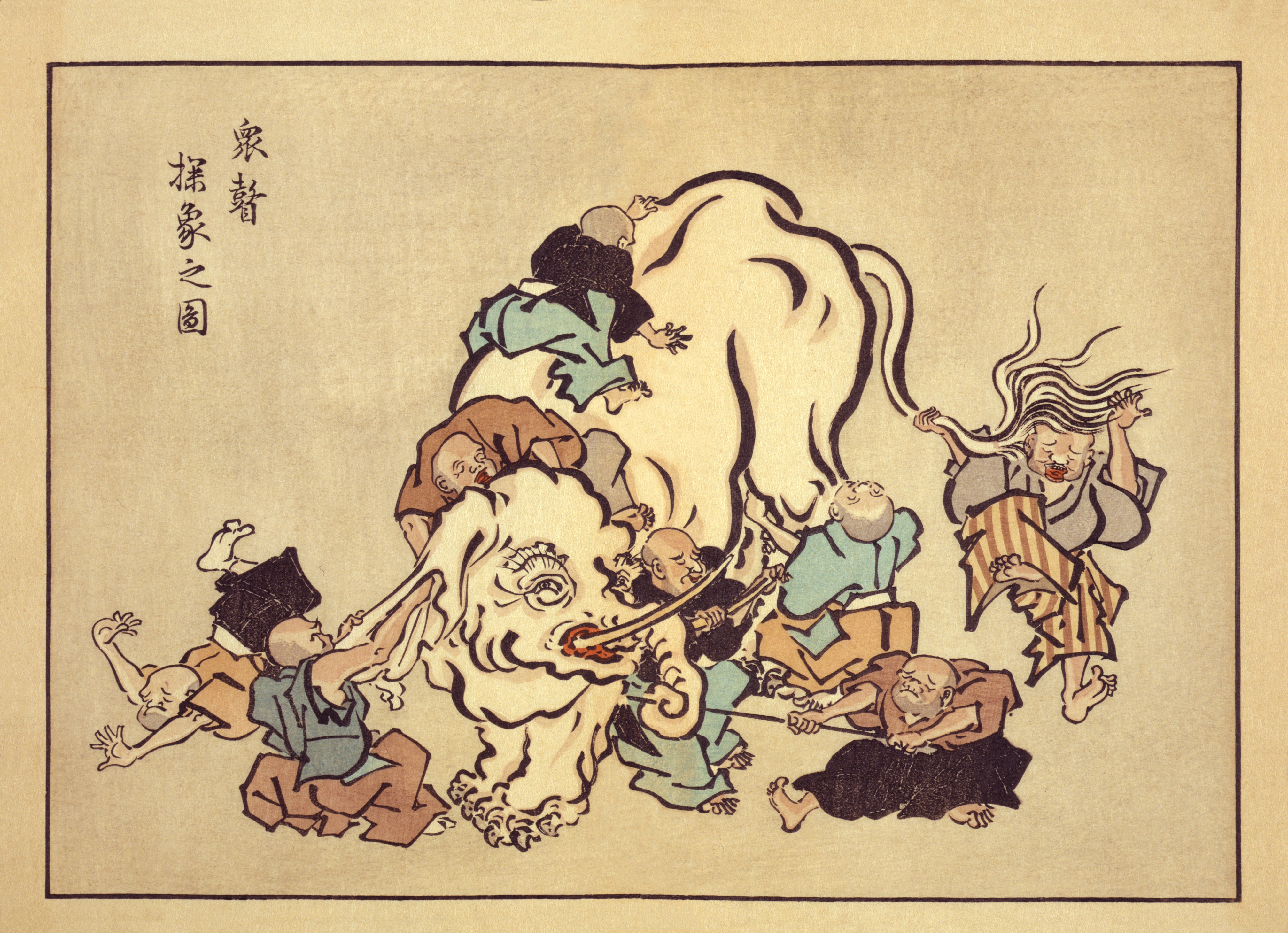
Both kinds of stories make claims about reality beyond the subjective. But even if science and/or religion have a claim on objective truth and ultimate meanings, the only way you and I get to experience that is though our own limited window on the world. It’s like the blind men in a room with an elephant, each being able to touch and know a small part of the Whole. The total creature, the ultimate Why, may exist or it may not. All we know - for sure – is that there many small creators of small, personal stories of what’s happening and what that may mean. Tiny beautiful proximate hows and infinitesimal, idiosyncratic whys. The meaning, and the arbiters moral value, are you and me, and our worldviews conform to that. To argue that a subset of views are special because there’s a special set of rules that applies only to them is delusional and/or disingenuous. You're reading my account of how I think different views fare under the same criteria. What you make of that, necessarily, is down to you.


Friday, 12 July 2013

Everybody Hurts - and everybody wants to tell you why.


Before, we spoke about Weird Shit. Today, I’d like to talk about Shit that’s actually…well, Shit.

I doubt you’ll find it controversial if I suggest that a strong candidate for poster child of the personal power of religious belief is the respite it can bring from suffering. One of the mainstays of debates on religion is the so-called Problem of Evil. In the abrahamic context, the Problem is the alleged inconsistency of a (one would really, really hope) benevolent god - who also happens to be omnipotent – and the existence of a world that quite patently, when you come down to it, isn’t all gumdrops and roses. I’d rather not get into the details of the centuries of philosophical wrangling that have occurred around this topic, but I do recommend this – by turns calculating, funny and insightful - wiki on the solutions  that have been put forward for this very sticky wicket. Indeed, I would say the real problem is one of Inconsistent Evil, rather than Evil per se. But that’s not our topic. For today at least.

What I draw from the boundless popularity of this trope is not the power of the argument itself but its topic – suffering, both in terms of specific unpleasantnesses and that more general, existential booboo lurking in all our souls – and the fact that any system of thought that wants its time in the sun has to grapple with its existence. Most religions seem to havethe same general responses: You deserve it (it’s your – or better yet, her - fault); it’s good for you; it doesn’t really exist if you would only look at it the right way. You pays your money, you makes your choice. I would say even ‘Science’ has its ideas on the subject. If you are partial to a bit of evolutionary psychology, you might contrast the environment Homo Sapiens sprung up in and the one in which it now finds itself. Take our appetite for sugar say, arguably adaptive in one context but ripe for maladaptive abuse in a context where such goodies are all too readily available. Or the ideas at the core of cognitive behavioral therapy, where anxieties and phobias are understood as the entraining of biological safety mechanisms like ‘flight or flight’ - that broadly and in aggregate are probably not a bad thing to have – to inappropriate stimuli or appropriate stimuli to an unhelpful extent.

Riffing on the theme that traditional doctrinal hooks are often not all that revealing about the beliefs of those that purport hang their hat of on them, do you find any of these answers – including the evolutionary one – all that convincing. At best, they might be – if we’re being charitable - explanations. But are they any of them consolations

I don’t know about you – and I would very much like to hear about you – but the perspectives that have helped, be they religious or not, have had some common features. They help you to see the hurt as not personal, not something that you have to worry about or register beyond the time in which they happen. They get you to count your blessings. There but for the grace of god go I. They let you submerge your ego into something, someone or some way bigger that yourself. They provide you with vistas that put your hurt into perspective, to count – carefully and with fuller knowledge of the alternatives – your lucky, lucky stars.

On the personal level, I suppose an explanation isn’t much use even supposing one or any is right. After an explanation, you still have to ask yourself - what now? At that point, I’m willing to let you have your life jacket, if you’ll do me the favour of letting me have mine.   

Photo by Agnonymous.


Friday, 31 May 2013

‘I’m a scientist, but I believe in love’ – What’s wrong with this sentence?


“My uncle was a scientist, but he believed that love is real. A kind of natural phenomenon.”
– Cloud Atlas, Megan Sixsmith (Zhu Zhu)
I’ve recently been reading a book – Consilience: The unity of knowledge – by the biologist E.O. Wilson, which I’d like to tell you about. The book is an analysis and re-statement of the enlightenment ideal of the unity, convergence or – in Wilson’s terms – consilience of scientific understanding. The dream was that we might trace the threads of causality across every possible level – from biology, through chemistry to physics. Wilson’s addendum is that we might also extend the methods and insights of the of the ‘hard’ sciences – particularly evolutionary psychology and populations genetics – to inform a cross-pollination between ‘the two cultures’, the natural sciences and the humanities. I don’t agree in all particulars, but contrary to some reviews I’ve read, this isn’t just materialistic triumphalism. I promise this is less a manifesto on how economics, anthropology, political science and philosophy have got it all wrong, and more a extended plea that the entrenched positions of the culture wars and their false dichotomies be put aside, so that a new and unfamiliar intellectual territory might be fruitfully explored by both traditions. I’m a neuroscientist by vocation, and only a philosopher by avocation, but I’ve noticed that people from the other culture tend to view such promises with suspicion. So, just go read the book – if nothing else the prose ain’t half bad.


Purity, by xkcd (http://xkcd.com/435/)

A good book is a good book, sure – but why blog about it here? Firstly, there’s Wilsons southern american christian background and the revelatory impact of being exposed at college to the neo-darwinian synthesis, as well as his frustration with the inability of people he’d known from childhood to see the merit of such a heathen perspective. Secondly, there’s the familiar way he appears to view the similarities between religion and science – both are seen as arising out of the wellspring of the human need for meaning – as well as their differences. While I can see religion as a valid approach to how people might choose to relate to the world and their place in it, for me science trumps religion for certain kinds of questions when you are interested in the world in and of itself – and for very specific reasons. Forgive the long extract, but I couldn’t put it better myself:      
                “There is nothing in science more provocative than a cleanly defined and surprising prediction, and nothing held in higher regard than such a prediction confirmed in detail. To this end, scientists look for four qualities in theory generally and mathematical models in particular.
The first is parsimony: the fewer the units and processes used to account for the phenomenon, the better. Because of the success of parsimony in the physical sciences, we do not today need an imaginary substance called phlogiston to explain the combustion of firewood, or nonexistent ether to fill the void of space.
The second quality is generality: the greater the range of phenomena covered by the model, the more likely it is to be true. In reagent chemistry the periodic table precludes a separate theory for each element and compound. One theory works exactly for all.
Next is consilience. Units and processes of a discipline that conform with solidly verified knowledge in other disciplines have proven consistently superior in theory and practice to units and processes that do not conform. That is why, in every scrap of data from every level of biology, from the chemistry of DNA to the dating of fossils, it has been the case that organic evolution by natural selection beats Creationism. God may exist, He may be delighted with what we are up to on this minor planet, but His fine hand is not needed to explain the biosphere.
And finally, drawing from all of the above virtues, the definitive quality of good theory is predictiveness. Those theories endure that are precise in the predictions they make across many phenomena and whose predictions are easiest to test by observation and experiment.”
- EO Wilson – Consilience: The Unity of Knowledge, Page 222
Another reason is Wilson’s consilience program – if materialistic science might inform and be informed by contact with the social sciences, might religion as a natural phenomenon then be within the rubric of science? Quite aside from any theoretical or empirical critiques of such a program, I’ve noticed when talking with religiously inclined people from the other other culture, that there’s a general view that some things are precious and better left unexplained or unexamined too closely.  Oddly enough, I don’t think any scientist sees themselves as in the job of removing wonder and magic from the world – or engaged in a war against irreducible complexity.  Rather - for me and at least the scientists I’ve had the opportunity to discuss this with - if anything, they feel like they are in the job of increasing it exponentially. I spoke before about how I like the image of all the things that are, have been, will be or might be in the world as facets of a great, gorgeous four-dimensional  crystal. The beauty of a worldview informed by the scientific method lies in how an increase in quantitative knowledge of the many, many facets of my world-crystal provides new levels and unexpected vistas of beauty, elegance, magic and complexity. They are all the more brilliant precisely because they do not necessarily conform to what the human mind might invent for itself.  Indeed, if the perspectives generated by human beings or gods, or both, are so special, why do their own adherents consider them so fragile that a closer look might irrevocably undermine them? 
“The love of complexity without reductionism makes art; the love of complexity with reductionism makes science.”
 - EO Wilson - Consilience The Unity of Knowledge, Page 67

Martin Rees’ cosmological ouroborus. Another pretty metaphor combining the mythical snake that eternally eats its own tale, and (to my mind) the cross-fertilization of knowledge at one scale of magnitiude that feeds back and informs that at other levels. Somewhere in the middle of the scale, you find humans. 
  
NOTE: please don’t be derailed by my use of ‘materialistic’ a couple of times in this post – I mean something philosophically specific, not the favouring of material things or a niave belief in the actual, material, really real existence of the world as we conceive it. I didn’t get into it here because its grist for the blogging mill – watch this space for a post on this subject in the hopefully not-to-distant future.