Saturday, 19 October 2013

Holy bookclub, Batman: The Gods of Fish and Men


Some recommended reading this time. Are you sitting comfortably? Then I'll begin...

Immense, of fishy form and mind,
Squamous, omnipotent, and kind;
And under that Almighty Fin,
The littlest fish may enter in.
Excerpt from Heaven, by Rupert Brooke.

 
I came across the poem ‘Heaven’, from which the above is an excerpt, in a book I’m reading at the moment, The Varieties of Scientific Experience by Carl Sagan. The title alludes to another book I’ve mentioned before: The Varieties of Religious Experience, by William James. Both are collections of the respective authors’ contributions to the Gifford Lectures on Natural Theology – the knowledge of god accessible not by revelation but by experience and reason. In 1901 James used his lectures to argue for the role of science in the study of religion, and set out his vision of what that might mean. Sagan - an astrophysicist and science communicator par excellence – used his lectures in 1985 to set out why he felt the proper exercise of scepticism does not preclude a sense of the sacred in our approach to the universe, but why human religions, such as they are, fail to capture it. Awe and wonder - says Sagan - are the only proper reactions to the majesty of creation, all the more so if we take modern ideas about its scale and complexity seriously. Indeed, it’s precisely the appreciation of this scale that makes earthly religions seem so parochial – for all the swarming diversity of human religious forms, they do not represent the full set of logically possible types of gods, beings and forces. Rather, they seem to speak to a much smaller set of conspicuously human concerns. Hence the poem: from a neutral perspective, would the anthropocentrism of our revealed religions appear all that different from the poem's fishy theology?

Sceptical scrutiny is the means, in both science and religion, by which deep thoughts can be winnowed from deep nonsense. - Carl Sagan

Another book I’ve read recently – Religion Explained , by anthropologist Pascal Boyer – also draws lessons from the ways in which human religion varies and the ways in which it seems to embody common concerns. He starts by outlining why religion unto itself is a phenomenon demanding an explanation, as a peculiar form of human behaviour and not just a specific manifestation of general cultural activity. He also set out why he thinks the common garden explanations typically proposed – religion as Existential Consolation, as Primitive Science, as Failure of Proper Thinking and so on – fail to do the job: no one of them accounts for the all the actual ways and manners in which religion is practiced. His proposal is that religious ideas and ritual activate a specific set of evolved psychological tendencies – that facilitates their general plausibility to mankind – in combination with specific violations of the expectations of those systems, explaining the endless interest such ideas engender. That’s a little lacking in detail I know, but I don’t want to get drawn into the detail here and the argument is set out in entertaining psychological and anthropological detail well worth the read even if you don’t buy his perspective. I’m not personally sure he succeeds in providing an explanation of religion in isolation. What I want to draw out here is the sense in which its easy to point to religious or spiritual feeling when you see it, but much harder to separate it off as a proper category all unto itself.

 “For small creatures such as we the vastness is bearable only through love.” - Carl Sagan

One domain in which people sometimes seek to maintain a thick and fast division between science and religion is ethics – insomuch as the latter is meant to be a proper source while he former is not. I’m all for appropriate wariness as regards the naturalistic fallacy (https://en.wikipedia.org/wiki/Naturalistic_fallacy) – deriving an ought from an is – but another of my recent reads has got me thinking about the ethics embedded in the practice of and motivation to do science. Its fiction this time, Antarctica by Kim Stanley Robinson. Among other things, it’s an exploration of the ideals embedded in science – the perfectibility or at least improvability of knowledge, the attempt to view things from outside of a human-centric perspective – and the treaty-model of Antartica as a ‘scientific resource’ as basis for our relationship with the natural world at large. It - along with the author’s excellent Mars Trilogy – is a compelling attempt to feel a way between humanity’s right to make use of the natural order to feed and sustain itself, and our duty as custodians to the very otherness and awe that we can all rightly agree is the only response to creation.
Carina Nebula
  “Science is not only compatible with spirituality; it is a profound source of spirituality. When we recognize our place in an immensity of light‐years and in the passage of ages, when we grasp the intricacy, beauty, and subtlety of life, then that soaring feeling, that sense of elation and humility combined, is surely spiritual. So are our emotions in the presence of great art or music or literature, or acts of exemplary selfless courage such as those of Mohandas Gandhi or Martin Luther King, Jr. The notion that science and spirituality are somehow mutually exclusive does a disservice to both.”
Carl Sagan, The Demon-Haunted World

 
NOTE: I recently came across this website (for which there also a .co.uk version too), which I can recommend if you are thinking of looking for any of these titles: http://www.betterworldbooks.com/. They “…collect and sell books online to donate books and fund literacy initiatives worldwide. With more than 8 million new and used titles in stock, we’re a self-sustaining, triple-bottom-line company that creates social, economic and environmental value for all our stakeholders.”

Creative Commons LicenceThis work is licensed under a Creative Commons Attribution-NonCommercial-ShareAlike 3.0 Unported License.

Saturday, 14 September 2013

Confessions of a Teenage Hope Fiend: How I learned to stop worrying and love the ‘Ommm….’.


"And then I did what all parents dread will happen to their children if they get into the wrong crowd - I started dabbling in philosophy. It all began with the weak, relatively harmless stuff: Sophie's World by Jostein Gaarder. But we all know that's a gateway to harder stuff, and that it inevitably leads to Kant and Heidegger."

-          Zoe Markillie, comment on the last post 
 

Hi, I’m Agnonymous, and I have a habit. 


Religion isn’t something I do, but I can’t leave it alone.


If I try to look back and find some precipitate event, all I see is evidence that I always had this need, this compulsion, to test the edges of my beliefs in the crucible of other peoples’. I see myself as a child deciding that I wasn’t going to sing the hymns at my primary school. I wasn’t Christian, so it wasn’t appropriate - right? Then - a little while later – it occurs to me that the value of the songs and the fun of singing them might be separate from their value as theology or a statement of belief. It might be okay for me to sing - and in any case while I may know what I’m not, it’s not at all clear what I am. It may have been fateful that I got in trouble for this – some fellow student asked why I was singing again, and for some reason took my “It was stupid” to refer to the songs and not my unwillingness to sing and thereby felt the only proper response was to inform The Authorities. One wonders what the teacher in question made of a nine-year old’s theology as a justification. In any case, I was still in trouble.  


Actually, defining yourself in terms of the negation of the other is handy when your own ideas are still a bit embryonic. Maybe that explains my rather staunch anti-theist pose in my early teens (even when it wasn’t indiscriminately anti-religious). This pose was odd, because no-one was really trying to impose a theistic point of view on me – my family if anything was possibly Buddhist, and a few jaunty hymns was about as religious as my school got. But a safely imaginary oppressor is a wonderful thing for a fragile identity, and it’s easier to explain you are against The Evil Church of Inquisition and  Dogma than that nice Dalai Lama man . This can be seen in the fact that some people I grew up with seemed fairly clear on their Christians, Muslims and Sikhs, but were less than 100% on the differences between Buddhists, Hare Krishna’s and Jews.


“Did it hurt when you were circumcised?”


As with any habit, terrible role models and a bad crowd didn’t help. Among these were The Ascended Master of Rhetoric incarnated in my father, as well as my very good friend who – despite apparently agreeing with me on all the ways the arguments for theism were ridiculous – remained stubbornly Muslim.  One terrible and two terrific Religious Education teachers later (Mrs H and Mr H, you’re the latter if you ever happen to read this), I’m just about ready to accept the idea that I might be less concerned with the ways in which I disagree with other people’s PoVs and lend some thought to what I do believe. It’s probably telling that at this point the one Argument For God I found difficult to respond to was Pascal’s Wager. The arguments points out - under the assumption of a existing god - the finite cost but infinite gain of belief (the good place) versus the finite gain but infinite cost of unbelief (the other place). If god doesn't exist, you've lose nothing by belief - its a finite cost for a finite 'benefit'. Given the distribution of risks and benefits, says the Wager, wouldn't the rational and reasonable man give that ol’time religion a go? Sure, one can make several responses (Wouldn’t such disingenuous belief –if it’s even possible – annoy god? Which god are we talking about, anyway?), but they’re mostly issues with its application, not a problem with the internal logic of the argument itself (compare this).  
   

So, I come to the point were I’m interested in working out whatI do believe. Theism was never my thing, but I dabbled in other habit-forming ideas – Wicca, Buddhism, vague-new-age-Spiritualism. I even spent some time as a lay community member in a Monastery. In fact, it was probably the latter that put the final nail in the idea that I was ever going to be a believer with a capital ‘b’. I was fascinated by religion: by the ritual trappings; the philosophy; the internal psychology of believers. I could even make use of the spiritual exercises I've learned for my own mental housekeeping. But a wholesale joiner of the club I was not, and probably never would be. 


So I’m more or less at peace with my obsession, now. I’m not offended by people’s beliefs or their Beliefs, in fact I’m often fascinated. On the other hand, I know what I think  and what I think I know, and I’ll fight my intellectual corner if I see the need. One is merely real life. The other is philosophy. And that’s serious


Creative Commons LicenceThis work is licensed under a Creative Commons Attribution-NonCommercial-ShareAlike 3.0 Unported License.

Friday, 6 September 2013

Ultimate Whys and Other Lies, on the Uses and Abuses of How.

"The magisterium of science covers the empirical realm: what the Universe is made of (fact) and why does it work in this way (theory). The magisterium of religion extends over questions of ultimate meaning and moral value. These two magisteria do not overlap, nor do they encompass all inquiry (consider, for example, the magisterium of art and the meaning of beauty)."


On my actual and ideal bookshelves, a good proportion of the biology and science section is taken up by the works of Stephen J. Gould. Primarily a palaeontologist and evolutionary biologist, he was also something of a renaissance man of science and reason-based letters – a historian of science and a popular essayist, a constructive gadfly of overzealous evolutionism and remorseless critic of ill-informed anti-evolutionism. A wielder of facts to defeat politicized science, and a relentless pointer-outer of great big elephants in our collective cultural rooms. 

As you may have guessed, I’m something of a fan. Paradoxically, that’s why I’m sort of avoiding another of his books that would be perfect fodder for this blog – see the quote at the start of the post. Not having read it, I’m not about to write some kind of pre-emptive review – and when I do read it I’m sure you’ll hear about it here. It’s not about disagreeing with him – I don’t agree with everything I’ve read of his previously and my enjoyment of his work is as much about how he says things as about what he says. As with C.S. Lewis, a worthy disagreement can be more satisfying than an easy consensus. It’s more that I came across this quote while researching a different post, and it seems to me to represent a conversational trope – as lazy as it common as it is oft-repeated - that might actually make me think less of one of my intellectual heroes if it is the argument he’s making.

Science, we are told, deals in the how. Religion, on the other hand, trades in the great and wonderful why. I don’t plan to stamp my feet and demand that science be let into the circle of arbiters of ultimate meaning. Rather, I want to challenge the idea that faith has unique – or any – access to the domain of transcendent meaningfulness. Indeed, on one level I doubt that it has any greater access than any other form of ‘how’.

Science and religion, on one level, are stories – whatever else they may be on other levels. For the supernatural there’s the range from fairy tale to the future history of the End of Days. For science you have the (actually incorrect but usefully didactic) atom-as-solar-system-model, and you have the standard model or quantum electrodynamics . Both are models for events, causal stories where this causes this by way of that. At this level, both kinds of stories are of the ‘how’ variety, but the claim is that one kind – religious stories – can level-up to the ‘why’ by virtue of their claims about transcendent realities and/or entities. But if these things are truly transcendent, aren’t they by necessity beyond the ken of people like you and me? Isn’t this precisely what we mean when we talk about the ‘mysterious ways’ in which god allegedly moves. Or, if you prefer, akin to the buddha’s unanswered questions.

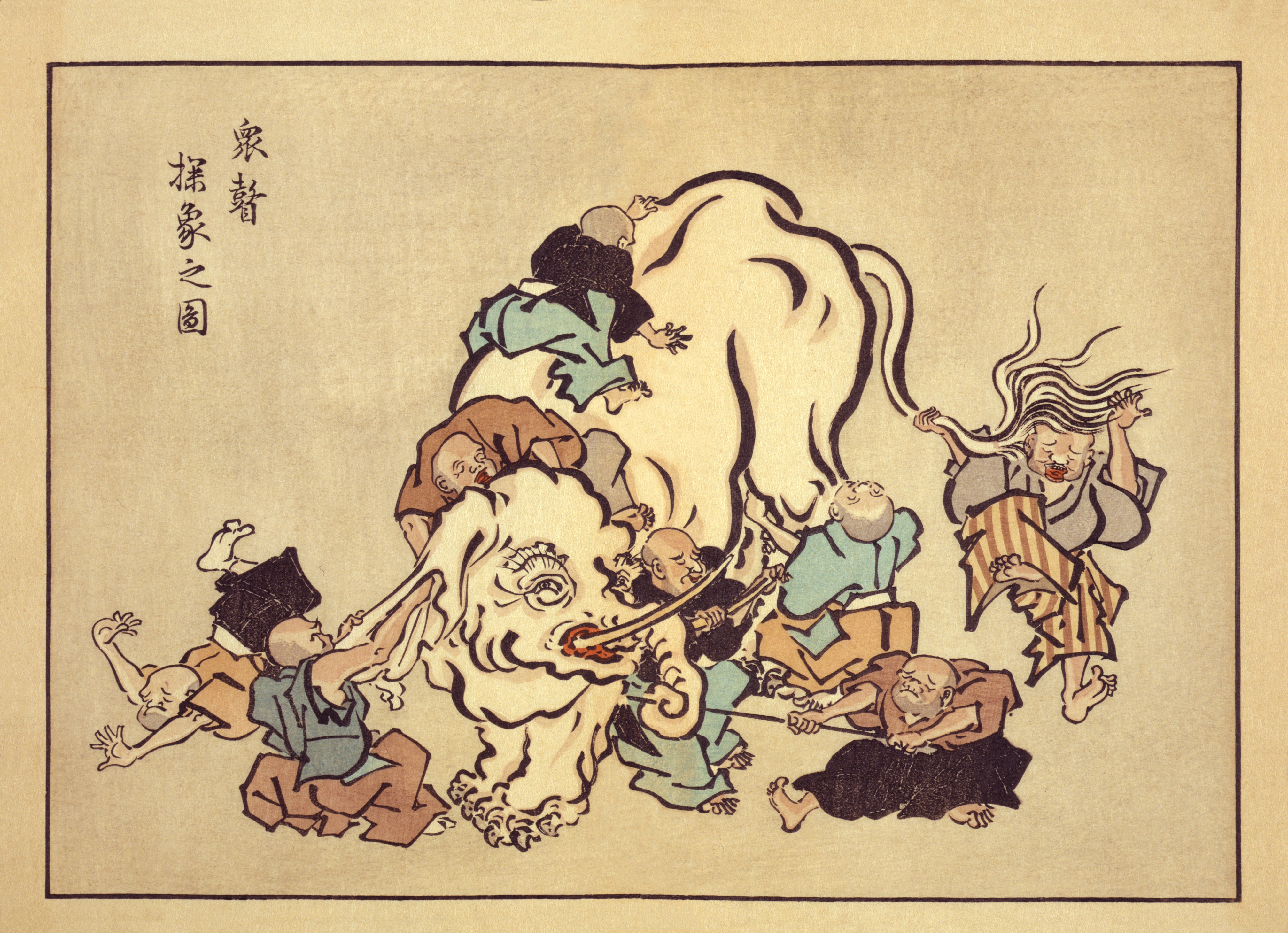
Both kinds of stories make claims about reality beyond the subjective. But even if science and/or religion have a claim on objective truth and ultimate meanings, the only way you and I get to experience that is though our own limited window on the world. It’s like the blind men in a room with an elephant, each being able to touch and know a small part of the Whole. The total creature, the ultimate Why, may exist or it may not. All we know - for sure – is that there many small creators of small, personal stories of what’s happening and what that may mean. Tiny beautiful proximate hows and infinitesimal, idiosyncratic whys. The meaning, and the arbiters moral value, are you and me, and our worldviews conform to that. To argue that a subset of views are special because there’s a special set of rules that applies only to them is delusional and/or disingenuous. You're reading my account of how I think different views fare under the same criteria. What you make of that, necessarily, is down to you.


Saturday, 31 August 2013

Give it a whirl: Berlin's Long Night of Religions, By Zoe Markillie

Earlier this year, the first Atheist Church was launched in London, with sermons on science by Professor Brian Cox, and Stevie Wonder hits replacing the usual hymns. The underlying principle was that a sense of community and unity in belief is something that need not be limited to the religious but rather should be shared by everyone, including atheists. In an ever-increasingly individualised world, so the theory goes, why not provide an opportunity for the unspiritual to gather every Sunday with like-minded people and discuss the big questions of life?

It’s not the first time that atheists have chosen to take something from religious practices, and I consider it for the most part a healthy attitude – or at least better than a Dawkinsesque ‘you’re all morons’ approach. And it’s a two-way process, with many religious groups becoming more and more open to outsiders. Which is how I ended up spending my Saturday night learning about the complex family tree of the Hindu gods, being hit in the face with the robes of a Whirling Dervish, and watching a Sikh put a book to bed.

As part of its cultural programme, Berlin organises a Long Night of Religions every year – all the places of worship around the city are open to visitors of any (or no) faith between 6pm and midnight, with many providing talks, demonstrations and music. Keen to learn about some of the less well-represented religions – like most Brits, my RE lessons consisted mostly of what Christians and Jews think about various issues – I didn’t bother with any of the churches or synagogues, and I had already visited a mosque during an open day last summer. So instead, the evening’s activities consisted of visits to a Hindu temple, a Sufi centre, a Buddhist temple and a Sikh gurdwara.

The warm welcome I received from all of these places seemed less of a sales ploy than I had expected; the people of the different faiths appeared to be genuinely pleased that I was interested in learning about their religion and not set on converting me. In particular, the Sikhs were openly willing to answer any questions, and insisted on serving us all food, despite the fact that we had guiltily snuck out of the prayer room before the end. And the Sufis not only did not require the female visitors to cover their heads, but also offered the same respectful welcome and ‘salaam alaikum’ to a group of girls who wandered in wearing strappy tops and hotpants.

As well as being educational in the expected sense, I also learned the first rule of watching Dervishes: don’t sit in the front row. But when not ducking out of the way of the spinning robes, I was struck by the elated expressions on their faces. Whatever incredible inner place they were in, I wanted to be there too. Sufism promotes joy and euphoria as a way of connecting with God, but could this be something that atheists can experience too?

As an oriental dancer, I have attended a few dance camps which involved a ritual called the ‘zar’. This is a middle-Eastern tradition which is a form of Dervish whirling for laymen; it is used for prayer, exorcisms, pain relief and general wellbeing. For us, it was a completely secular religious experience – entering a trancelike state of pure elation without the accompanying connection to a higher being.

I was extremely nervous before my first zar; I’ve always been too sceptical even for meditation, and this seemed to be a weirdly pagan, cult-like ritual. We were led into a dimly-lit space and told to move in whatever way felt right; we needn’t worry about safety as there were supervisors to make sure we didn’t hurt ourselves. Zar, unlike Dervish whirling, is not at all a performance; it is not a pretty sight, and the only people who may be present, other than the participants, are there purely for safety reasons.

As the repetitive Sufi drumming began, I felt ludicrous and self-conscious. I had no idea what to do. I sneaked a glance at the others from the corner of my eye and began to follow suit, turning slowly on the spot. At first, the hardest thing was to remember that this was NOT a performance; as I spun, I had to crush my dancer’s instinct to hold my arms in a beautiful pose and to spot in order to avoid dizziness. The dizziness was part of it. Memories of spinning on the school playground until I fell over, just for the fun of it, came flooding back and I began to enjoy myself.

Unlike Dervish whirling, zars are not limited to on-the-spot turning, and whenever I got tired, I would fall to my knees and fling my head and arms from side to side. The wild movements came naturally now, and I could neither see nor care if anyone was watching me. My limbs were loose and felt separate from my body; my hair was in my eyes and mouth but I didn’t feel it; I simply felt a compulsion to move to the heavy drum beats. I was in a trance without drugs or hypnosis, an entirely self-constructed trance.

Finally, the music came to an end and we all lay still on the floor. Once recovered, we were led one at a time from the room and to our beds. Confused and disorientated, I asked one of the supervisors how long I had been in there – it felt like about ten minutes. She smiled and told me I had just thrown myself around in a dark room for an hour.

The zar affects everyone in different ways. Most feel high, dizzy and very relaxed. For some, the feeling of elation is so intense that they laugh hysterically – as I shuffled to my bedroom, I could hear their cackles echoing down the corridor, and a few dancers are well-known for needing at least 45 minutes to stop giggling after a zar. Others cry uncontrollably for no apparent reason. I know one woman who does the zar every year, and afterwards wails for half an hour with huge, racking sobs that seem to come from some deep unimaginable pain; she assures me she’s not crying about anything in particular, and that she finds it rather therapeutic.

Personally, I feel mostly drunk – carefree, uninhibited, but always aware of what I am doing, and with the feeling that I could stop at any time if I wished. I certainly feel relaxed and happy, but I can never quite reach the peaceful place of the Whirling Dervish. The euphoria rises, and I feel like there could be a connection – but there never is. Is this a problem in me, an inability to allow myself to connect to something greater, or simply that there is nothing to connect to at all? And does it matter in any case, if an atheist can have more or less a religious experience without God?

  Some rights reserved by Chadica


Saturday, 24 August 2013

A church wedding for a secular couple. Guest Post by Nick Thorne.


There is something strange about an increasingly common phenomenon: secular couples having church weddings. Of course there’s a certain logic to it – many couples who hold no religious beliefs still feel that a church is the proper place for a wedding. Family expectations of a traditional wedding can exert pressure. For most people in Britain today the church plays no significant role, and more often than not, the desire to have a church wedding stems from a conservative taste in décor and an insistence on tradition, rather than from any religious sentiment. Understandably, churches resent merely being used as a pretty venue, and as they have what the couple wants, they use their advantage to insist on keeping some of the religious formalities. This creates an absurd situation in which just about everyone concerned is obliged to say things that they don’t mean, on an occasion for which honesty is absolutely crucial. 


Attribution Some rights reserved by Eusebius@Commons
It begins with the rule that you have to be a member of the parish in order to be married in that particular church. Many secular couples will not be a part of any parish and have often not been to church for years. In order to be allowed to get married in church, they have to turn up on a Sunday for a certain period before their wedding. That seems fair, but what does it actually achieve? The priest has to pretend to be convinced by the couple’s religious fervour, despite knowing full well that in virtually every case, the couple will never set foot in the church again after their wedding. And the couple know that they are deceiving the priest, an uneasy feeling to have during their wedding preparations.

During the church service itself on the wedding day the priest introduces the party to a short overview of Christian teaching on marriage. There’s a vague allusion of the commitment to have children, but there’s certainly no mention of St Paul’s teachings in the New Testament, that a man should strive for celibacy. While it’s a step forward that such fundamentalist texts have been quietly dropped, you’re left wondering whether there is anything specifically “Christian” in the priest’s preamble at all. And if there isn’t, why bother with the whole charade in the first place?

In the marriage vows, the couple have to repeat after the priest, that they are entering into a union together in the presence of the Father, Son and Holy Spirit. This seems somewhat problematic if the couple in question doesn’t hold a Christian belief. A marriage has to be founded on an honest commitment between two people – a system which forces the couple to begin their life together by professing a belief they do not hold is absurd. 

It will be interesting to see how this phenomenon evolves over the coming decades. As the older generation passes away, the proportion of religious believers and church goers will decrease further, but many will still like the idea of a church wedding. Perhaps churches will become even laxer in the demands they place on secular couples. Perhaps certain Christian denominations or priests will allow their churches to be used for secular weddings, or communities will be able to purchase or take over churches as they become vacant. In any event, it is difficult to see how the strange contradictions of church weddings for secular couples can continue much longer.


Friday, 12 July 2013

Everybody Hurts - and everybody wants to tell you why.


Before, we spoke about Weird Shit. Today, I’d like to talk about Shit that’s actually…well, Shit.

I doubt you’ll find it controversial if I suggest that a strong candidate for poster child of the personal power of religious belief is the respite it can bring from suffering. One of the mainstays of debates on religion is the so-called Problem of Evil. In the abrahamic context, the Problem is the alleged inconsistency of a (one would really, really hope) benevolent god - who also happens to be omnipotent – and the existence of a world that quite patently, when you come down to it, isn’t all gumdrops and roses. I’d rather not get into the details of the centuries of philosophical wrangling that have occurred around this topic, but I do recommend this – by turns calculating, funny and insightful - wiki on the solutions  that have been put forward for this very sticky wicket. Indeed, I would say the real problem is one of Inconsistent Evil, rather than Evil per se. But that’s not our topic. For today at least.

What I draw from the boundless popularity of this trope is not the power of the argument itself but its topic – suffering, both in terms of specific unpleasantnesses and that more general, existential booboo lurking in all our souls – and the fact that any system of thought that wants its time in the sun has to grapple with its existence. Most religions seem to havethe same general responses: You deserve it (it’s your – or better yet, her - fault); it’s good for you; it doesn’t really exist if you would only look at it the right way. You pays your money, you makes your choice. I would say even ‘Science’ has its ideas on the subject. If you are partial to a bit of evolutionary psychology, you might contrast the environment Homo Sapiens sprung up in and the one in which it now finds itself. Take our appetite for sugar say, arguably adaptive in one context but ripe for maladaptive abuse in a context where such goodies are all too readily available. Or the ideas at the core of cognitive behavioral therapy, where anxieties and phobias are understood as the entraining of biological safety mechanisms like ‘flight or flight’ - that broadly and in aggregate are probably not a bad thing to have – to inappropriate stimuli or appropriate stimuli to an unhelpful extent.

Riffing on the theme that traditional doctrinal hooks are often not all that revealing about the beliefs of those that purport hang their hat of on them, do you find any of these answers – including the evolutionary one – all that convincing. At best, they might be – if we’re being charitable - explanations. But are they any of them consolations

I don’t know about you – and I would very much like to hear about you – but the perspectives that have helped, be they religious or not, have had some common features. They help you to see the hurt as not personal, not something that you have to worry about or register beyond the time in which they happen. They get you to count your blessings. There but for the grace of god go I. They let you submerge your ego into something, someone or some way bigger that yourself. They provide you with vistas that put your hurt into perspective, to count – carefully and with fuller knowledge of the alternatives – your lucky, lucky stars.

On the personal level, I suppose an explanation isn’t much use even supposing one or any is right. After an explanation, you still have to ask yourself - what now? At that point, I’m willing to let you have your life jacket, if you’ll do me the favour of letting me have mine.   

Photo by Agnonymous.